Great Lakes Cryptids: Water Monsters in America's Biggest Lakes
Five Lakes, One Long Sighting Record
The Great Lakes hold 5,439 cubic miles of water across five basins, from Lake Superior's 31,700 square miles down to Lake Ontario's 7,340. Superior drops to 1,332 feet. Erie, the shallowest, averages 62 feet. Those numbers matter, because the monster reports do not track them the way you would expect.
A note on what follows. Nothing here is a confirmed animal. What these lakes have is a sighting record: newspaper accounts reaching back to the 1790s, a handful of named creatures, a hoax its perpetrators eventually confessed to, and one very large real fish that keeps turning up in the middle of the story. Here is who is reported in each lake.
Lake Erie: Bessie, and the Names She Answers To
Erie is the shallowest of the five, averaging 62 feet with a maximum of 210. Of the five files surveyed on this page, Erie's is the oldest in print and the one written about most often. The Ohio shore (Ohio holds most of it) has been watching this water for two centuries.
The file opens in 1793, or in 1817, depending on which account you take. Cleveland Magazine and Cleveland Scene both date the first sighting to 1793, when the captain of the sloop Felicity is said to have startled a giant serpent in the shallows of the Lake Erie islands. Wikipedia tells the 1793 story with a different ship, the sloop Bay Rat, north of Sandusky, the captain shooting at ducks, the animal "more than a rod" long, and marks the whole item as uncited. Its own opening line dates the first recorded sighting to 1817 instead. The 1817 report is the one with a name attached: the science writer Constantine Samuel Rafinesque published an account of a serpent seen on July 3 of that year by a schooner three miles from shore, 35 to 40 feet long, a foot in diameter, dark brown or black.
On July 31, 1818, the Cleaveland Gazette & Commercial Register ran a ship's close encounter with a monster in the lake. The beast "hissed" and "lashed water with his tremendous tail." Cleveland Magazine reports that historians, among them Case Western Reserve University's John Grabowski, read that piece as an allegorical broadside at the Second Bank of the United States rather than a literal monster attack. One of the earliest Great Lakes monster stories in print may have been a political cartoon written as prose.
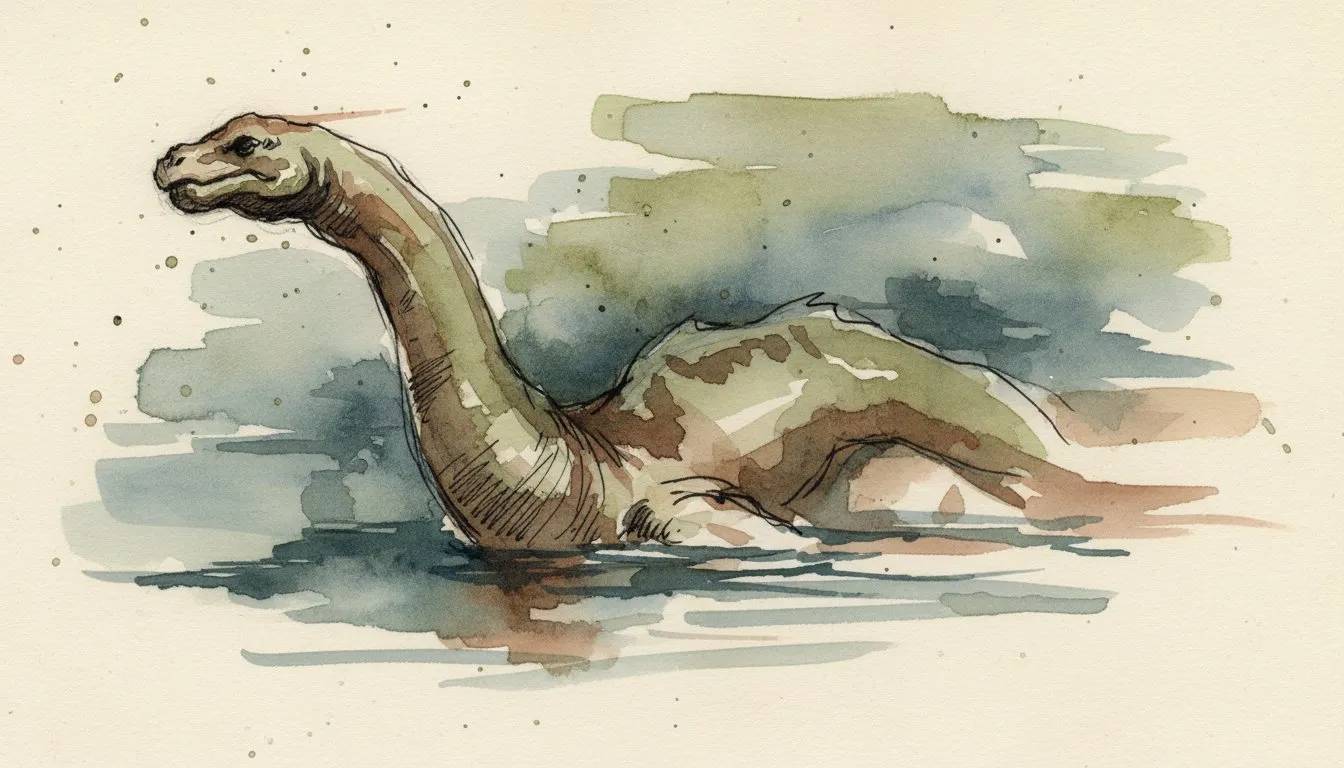
The composite description that stuck is snake-like, 30 to 40 feet long, at least a foot in diameter, grayish. The individual reports are far less tidy than that. Cleveland Scene's catalog runs from a "fish with arms" of 20 to 30 feet, beached west of Port Clinton in 1887, to a 50-foot finned creature seen from the schooner Madaline in 1892, to a 35-foot serpent with eyes the size of silver dollars in 1896. Lengths span 20 to 50 feet and colors run from black to gray.
She got her name in 1989, when the Ottawa County Beacon ran a naming contest and pulled "South Bay Bessie" from 115 entries. Bessie rhymes with Nessie, which is most of the reason. She is also called the Lake Erie Monster, and Lemmy, a nickname assembled from that phrase's initials. A wood and plastic Lemmy sculpture by Len Tieman stood in the Huron River just north of Ohio Route 2 near Huron in 1994, visible to drivers on the bridge. It was later damaged and removed.
Those are four names for one animal in one lake. Bessie, South Bay Bessie, the Lake Erie Monster, and Lemmy all point at the same reported creature in Lake Erie. Roundups that split them, usually by handing "South Bay Bessie" to Lake Ontario, have made a filing error rather than a discovery. Lake Ontario has its own creatures. This is not one of them.
Sightings clustered again through the 1980s and 1990s. Two Cleveland Coast Guardsmen reported a snakelike animal off a municipal beach in 1985. In 1990, two Huron firefighters, one of them a retired Coast Guardsman, described a humped shape some 35 feet long that they insisted was neither a log nor a sea wall. That November the Huron town council passed a resolution designating itself an official monster capture and control center. Amid the same publicity push, the owner of the Huron Lagoons Marina had Lloyd's of London underwrite a $102,700 reward for anyone who caught South Bay Bessie, or any unknown aquatic animal of at least 1,000 pounds and 30 feet, alive and well. Wikipedia separately records an undated $5,000 reward offered by a local marina owner, Thomas Solberg. Nobody collected either.
The most useful witness in the whole Erie file was eleven years old. On a July evening at Huntington Beach in Bay Village, a beachful of onlookers watched a ridged back rise out of the water and put it at somewhere between 25 and 50 feet long. Among them was Victor Rasgaitis, there with his family. His own account is smaller and better than the crowd's: "It came up a foot out of the water, just this crest. It looked like water, but sort of solid." He went home, paged through volumes of animal life, and decided that what he had seen most resembled a gigantic sturgeon. Hold onto that.
Lake Ontario: Kingstie, and the Barrel in Cartwright Bay
Ontario is the smallest Great Lake by surface area, 7,340 square miles, and reaches 802 feet deep. Its serpent reports are old, and read in sequence they are instructive.
On the morning of July 25, 1821, John Maupin of Montreal and James Sigler of Jefferson County, New York, swore before a Niagara justice of the peace that from the canoe Lightfoot they had met an animal at least thirty-seven feet long and two and a half feet in diameter, covered in black scales, thrusting out a large red tongue. The Oswego Palladium printed their affidavits on September 14, 1821, reprinted from the Niagara Democrat. On July 1, 1833, the Palladium carried Captain Abijah Kellogg of the schooner Polythermus, who described a serpent he had watched on the evening of June 15 while making for Kingston harbor: about 175 feet long, dark blue spotted with brown, thick as a flour barrel through the middle, in sight a full fifteen minutes.
Then, in September 1867, amid a fresh round of serpent stories in the press, the Commercial Press of Pultneyville printed the deflation. Henry Stowell of Oswego said the animal was his, and that he had imported it at great expense from the Humbug Islands.
The creature that stuck has a name and a town. Kingstie, named for Kingston, Ontario, is described in Ontario folklore as a snake-like beast over nine metres long with short legs and a tail. In the summer of 1882, onlookers reported a bluish-grey serpent with prominent bristles lazing belly-up at the surface, soaking up the sun, before it dove.
Then Cartwright Bay. In the late summer of 1934, people east of Kingston reported a creature with the head of a dragon and eyes of fire. An expedition rowed out, and its boat was jostled. In 1979, three people from Kingston explained the mechanism: a barrel filled with empty bottles to float it, a dragon's head fixed to one end, an anchor and rope to hold it in place, and twine run below the surface so they could bob it up and down from a distance. Forty-five years is a long time to let a story run.
Long before any of that, the Seneca spoke of Gaasyendietha: an enormous fire-breathing serpent that could also fly, born either from serpent eggs or arriving on a meteor, which is why it is sometimes called the meteor dragon. It belongs to Seneca oral tradition and cosmology, not to a sightings file, and filing it as an early Kingstie report gets the category wrong.
Lake Michigan: The Serpent That Turned Out to Be a Sea Lion
Michigan covers 22,300 square miles and drops to 925 feet. Its monster is less a creature than an episode.
In 1867 the crews of the tugboat Crawford and the propeller Skylark reported a near-confrontation with the beast off the coast of Evanston, Illinois, the animal "lashing the waves with his tail." On a clear day in late March 1893, Captain H. R. Brinkerhoff at Fort Sheridan and Lieutenant W. F. Blauvelt watched something about thirty feet long, with a very large head, dark above and light underneath, that Brinkerhoff said looked like an alligator's. It described almost a letter S with its body as it turned. Brinkerhoff thought the animal benumbed or disabled.
In 1903 a fisherman reported a serpent off 22nd Street. Ninety years later the Chicago Tribune named what it had been: Big Ben, a sea lion, escaped from the Lincoln Park Zoo. That is a newspaper looking back across ninety years, not a specimen on a table, and it is worth holding at exactly that weight.
Still, it is the Lake Michigan file compressed into one line. A real animal, in the wrong water, seen by people with no reason to expect it.
Lake Superior: Pressie, and the Deepest Water on the List
Superior is the largest freshwater lake on Earth by surface area, 31,700 square miles, averaging 483 feet deep and reaching 1,332. It is cold, dark, and mostly unwatched.
Its creature is Pressie, named for sightings near the Presque Isle River, which runs through Michigan's Upper Peninsula and empties into Lake Superior. The full file lives on its own page.
Superior's oldest usable account predates the name. On July 31, 1895, the Detroit Free Press carried Captain George Robarge of the propeller S. S. Curry, who said he had seen the thing at sunset near Whitefish Point on his last trip down from Duluth. Its neck was some fifteen feet in length, its jaws parted a foot or more. It kept pace with the propeller for a full five minutes. The captain, the second mate, and the watchman all watched it through the glasses.
Lake Huron: The Lake Without a Name
Huron is the second largest of the five by surface area, 23,000 square miles, with 3,827 miles of shoreline including islands, an average depth of 195 feet and a maximum of 750.
And no Huron creature has entered the popular record the way the others have. Erie named Bessie. Ontario named Kingstie. Superior named Pressie. Huron never settled on anything.
That absence is the most interesting fact on this page, because it cuts against the intuition that monsters come out of deep water. Huron is three times deeper than Erie on average and has more shoreline than any of the five. What Erie has that Huron does not is a crowded, industrial, heavily boated southern shore lined with newspapers. Lake monsters of this kind are not produced by depth. They are produced by witnesses, and by somebody with a printing press who wants the story.
Be clear about what is being counted, though. This page counts nicknamed creatures with sighting files and newspaper clippings behind them. Anishinaabe water beings are a different category, and the next section is about why.
Mishipeshu Is Not a Cryptid
Most Great Lakes monster roundups eventually reach for Mishipeshu, the underwater panther, and most of them handle it badly.
Mishipeshu belongs to Ojibwe and wider Anishinaabe tradition. The word is current rather than archaeological: the Ojibwe People's Dictionary, maintained through the University of Minnesota's Department of American Indian Studies, glosses mishibizhii as a lion, a panther, an underwater panther. At Agawa Rock, a lakeside site in Lake Superior Provincial Park about 150 kilometres north of Sault Ste. Marie, Mishipeshu appears in red ochre among more than a hundred images painted on the cliff by Ojibwe spiritual leaders. Writing in The Walrus in 2019, Adam Leith Gollner described Mishipeshu as the Ojibway demigod of the waves and of sudden aquatic turbulence, and Agawa Rock as a place where Batchewana First Nation knowledge keeper Rodney Elie holds vision fast ceremonies. "I'll do this for the rest of my life," Elie told him. "I'll never stop."
That is the point. This is a living spiritual tradition with living practitioners, on a shoreline their communities have never left. It is not an eyewitness report. It is not a monster sighting. It does not belong in a tally with Bessie and Kingstie, and this site does not count it as a cryptid.
The Sturgeon on the Table
Lake sturgeon are real, they live in these lakes, and they are the mundane explanation most often reached for. Cleveland Magazine, surveying the Lake Erie record, calls "a sturgeon grown to unusual size" the most mundane and logical explanation for the earnest sightings.
It is not the only candidate, and it was not the expert's. Charles Herdendorf, the Ohio State University oceanographer and zoologist actually consulted during the 1990 flap, thought South Bay Bessie was an illusion created by schools of the lake's plentiful carp, herded into serpentine strings by sandbars and shallows. One witness to a multi-humped shape rejected the sturgeon outright.
Still, the fish is worth looking at. The U.S. Fish and Wildlife Service puts typical adult lake sturgeon at 4 to 6 feet, 30 to 80 pounds, living 50 to 100 years. The largest and oldest reach about 7 feet, weigh 200 to 300 pounds, and live to 150. A Service feature on Great Lakes sturgeon calls them "monstrously large fish" and notes they "cruised through waters when dinosaurs roamed the earth." They carry a bony, plate-armored covering and trail whisker-like barbels from their snouts.
Then the disappearance. Lake sturgeon were once abundant in Lake Erie and the Ohio River, the Ohio Division of Wildlife reports, and declined across the last 150 years under dams that blocked the spawning sites and unregulated harvest. Ohio lost all of its known spawning populations. Lake sturgeon are a state-endangered species there today.
Which sets up the part of this story that is still running. The Division of Wildlife and its partners have released juvenile lake sturgeon into the Maumee River every year since 2018, and in 2025 the program expanded to the Cuyahoga, Sandusky, and Scioto. A University of Toledo telemetry study, announced in June 2026 and published in the Canadian Journal of Fisheries and Aquatic Sciences, tracked fish released in 2018, 2019, and 2021. Of 94 detected sturgeon, 74, or 79 percent, moved out of the Maumee into Lake Erie after release, then spent the bulk of their first year in the lake's western basin, mostly hugging the south shore.
Be precise about what the sturgeon explains and what it does not. A seven-foot fish is not a forty-foot serpent. What it explains is the shape of the report: a dark, ridged back breaking the surface where nothing that size is supposed to be, in a lake where the fish that size were killed off before anyone now living had seen one. Add wave trains, drifting timber, one escaped sea lion, three people with a barrel, and the ordinary human talent for pattern-matching in bad light, and most of the file resolves.
Most of it. Victor Rasgaitis reasoned his way to the sturgeon answer at eleven years old, and he still saw something.
Are Bessie and South Bay Bessie two different creatures?
No. They are one creature in one lake. Bessie, South Bay Bessie, the Lake Erie Monster, and Lemmy are all names for the serpentine animal reported in Lake Erie, and "South Bay Bessie" specifically was the winning entry in a 1989 naming contest run by the Ottawa County Beacon. Lists that assign South Bay Bessie to Lake Ontario have duplicated one creature into two. Lake Ontario's own creatures are Kingstie and, in Seneca oral tradition, Gaasyendietha.
Which Great Lake has the most monster reports?
Nobody has counted them lake by lake, so this cannot be settled. What can be said is that of the five, Lake Erie's file is the oldest in print and the one written about most often, with reports running from the 1790s through the 1990s. Erie is also the shallowest, averaging 62 feet against Superior's 483. If depth produced monsters, the ranking would run the other way. What Erie has is a busy, well-documented shoreline: boaters, commercial fishermen, beachgoers, and newspapers.
Is there really a monster in the Great Lakes?
There is no confirmed one. No body, no bone, no unambiguous photograph. Monster-sized forms have been claimed on fish-finder sonar and in satellite images, and none of them has been confirmed; the satellite traces may have been mud or marl stirred up by boats in the shallows. What exists is a long, uneven record of people describing something dark and long that surfaced and left. Two of the best-known cases have come apart. The 1934 Kingston creature was a barrel with a dragon's head, confessed to in 1979. The 1903 Lake Michigan serpent was identified by the Chicago Tribune, ninety years after the fact, as Big Ben, a sea lion escaped from the Lincoln Park Zoo. Lake sturgeon, which reach about seven feet and are being deliberately restored to Lake Erie, account for a good share of what is left. That is where the evidence sits.
Watching the Water
Summer puts millions of people on these lakes: charter boats out of Port Clinton, kayakers in Georgian Bay, freighters running the length of Superior. That is when the reports come in, because that is when there is somebody there to make one.
The position here is the same as it is everywhere in this archive. The witnesses are not liars. The sturgeon is not a dodge. The file stays open until something closes it.
For the wider picture, read lake monsters beyond Nessie and Chessie, the Chesapeake Bay serpent. For accounts from people in the water rather than watching from a boat, see the summer swimming hole cryptids. For the saltwater version of the same argument, read the case for sea serpents being something real.
The lakes are only part of the regional record. For the creatures reported on land across the same twelve states, from the Beast of Bray Road to the Van Meter Visitor, see our guide to Midwest cryptids.
Explore the creatures: Pressie, Loch Ness Monster, the Lake Monsters collection, and every creature in the vault.
Get the Field Notes.
Field notes from the Vault, when there is something worth sending. No spam.
No spam. Unsubscribe anytime.