
Nandi Bear
Also known as: Kerit, Chimisit, Duba
Kenyan tribes fear a nocturnal beast that kills for one thing only: the brain.
1905
Nandi Hills, western Kenya
4-5 feet at the shoulder
Highly aggressive, nocturnal hunter
Unverified
The Lore
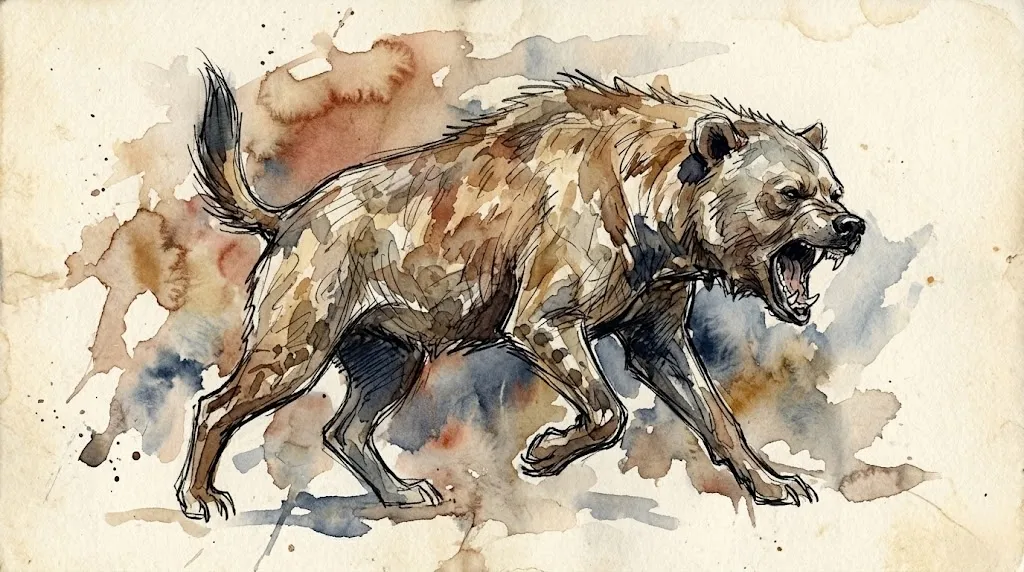
The Nandi Bear is a large, aggressive nocturnal creature reported by the Nandi people of western Kenya. Described as a stocky, bear-like animal larger than a hyena with a sloping back and reddish-brown fur, it allegedly attacks humans and livestock, specifically targeting the brain. Multiple colonial-era settlers and officials reported encounters. Its identity remains debated, with theories ranging from a surviving chalicothere to an abnormally large hyena.
East Africa's colonial era produced a rich catalog of anomalous animal reports, and among the most persistent and puzzling was the Nandi Bear - a creature described by settlers, colonial administrators, and members of the Nandi and Luo peoples of western Kenya as a large, aggressive carnivore unlike anything in the known African fauna. Reports concentrated in the area around the Nandi Hills and the Uasin Gishu plateau during the late nineteenth and early twentieth centuries, with witnesses describing an animal of powerful build, coarse hyena-like fur, a hunched profile, and disproportionately large forequarters relative to its hindquarters. The creature was reportedly feared by local communities as an exceptionally dangerous predator and was held responsible for cattle kills and, in some accounts, attacks on humans.
Colonial officer and naturalist C.W. Hobley documented multiple Nandi Bear accounts in his 1912 paper and subsequent writings, noting the consistent descriptions provided by witnesses of different backgrounds. The creature was described as nocturnal, capable of great speed over short distances, and particularly distinguished by the way it killed its prey - reportedly attacking the skull and consuming the brain, a behavior noted in accounts from multiple independent sources across several decades. P.H.G. Powell-Cotton, a professional hunter with extensive African experience, reported a sighting in 1907 that he could not explain through any known species.
Hypotheses about the Nandi Bear's identity span an unusually wide biological range. The spotted hyena and the striped hyena have both been proposed as explanations for some sightings, particularly given the hunched profile and bone-cracking dentition common to hyenas. More ambitious proposals invoke Chalicotheres, large extinct perissodactyl mammals with disproportionately powerful forequarters, whose fossils have been found in African deposits. A surviving giant baboon of unusual size and aggression has also been suggested, as has an unknown species of large mustelid. Some researchers have pointed to the Bili Ape - a large, ground-dwelling chimpanzee described from the Democratic Republic of Congo - as evidence that large, anomalous primates can remain undescribed in African forests.
The Nandi Bear ceased to generate new reports after the mid-twentieth century, as the Nandi Hills region became more densely settled and the wildlife of western Kenya came under more systematic observation. Whether it represented a genuine unknown, a misidentified known animal, or a product of colonial-era pattern-matching remains one of the more substantive unresolved questions in African anomalous zoology.
Notable Witnesses
- Geoffrey Williams
- Major Braithwaite
Further Reading
No book is devoted to this creature. These are the general references that cover the field, plus a direct search if you want to dig further.
- Cryptozoology A to Z by Loren Coleman and Jerome Clark (1999)
The standard one-volume encyclopedia, roughly two hundred entries covering creatures, investigators, and hoaxes.
- Mysterious Creatures: A Guide to Cryptozoology by George M. Eberhart (2002)
The larger reference guide, stronger on sourcing and on creatures that never reached the popular books.
Search Amazon for Nandi Bear books
As an Amazon Associate, Cryptid Vault earns from qualifying purchases. Links open Amazon in a new tab.
Get the Field Notes.
Field notes from the Vault, when there is something worth sending. No spam.
No spam. Unsubscribe anytime.
You might also like
Mngwa
A gray, brindled cat the size of a donkey has been mauling people in Tanzania since the 1900s.
Dingonek
A saber-toothed, armored aquatic predator was reported in a Kenyan river by a big-game hunter in 1907.
Agogwe
Across East Africa, multiple credible witnesses have reported small, rust-colored ape-men walking upright.
Muhuru
In a remote Kenyan river valley, locals describe an armored, club-tailed reptile that has no business still existing.
Grootslang
South African legend says the gods made a creature so powerful they had to split it into elephants and snakes.
Jersey Devil
A bat-winged, hoofed terror born from a colonial curse in the Pine Barrens.
Ozark Howler
A horned, shaggy beast whose eerie howl echoes through the Ozark hills at night.
Popobawa
Zanzibar's most feared entity attacks at night and demands that victims tell others, or it returns.