
Ningen
Also known as: Antarctic Humanoid
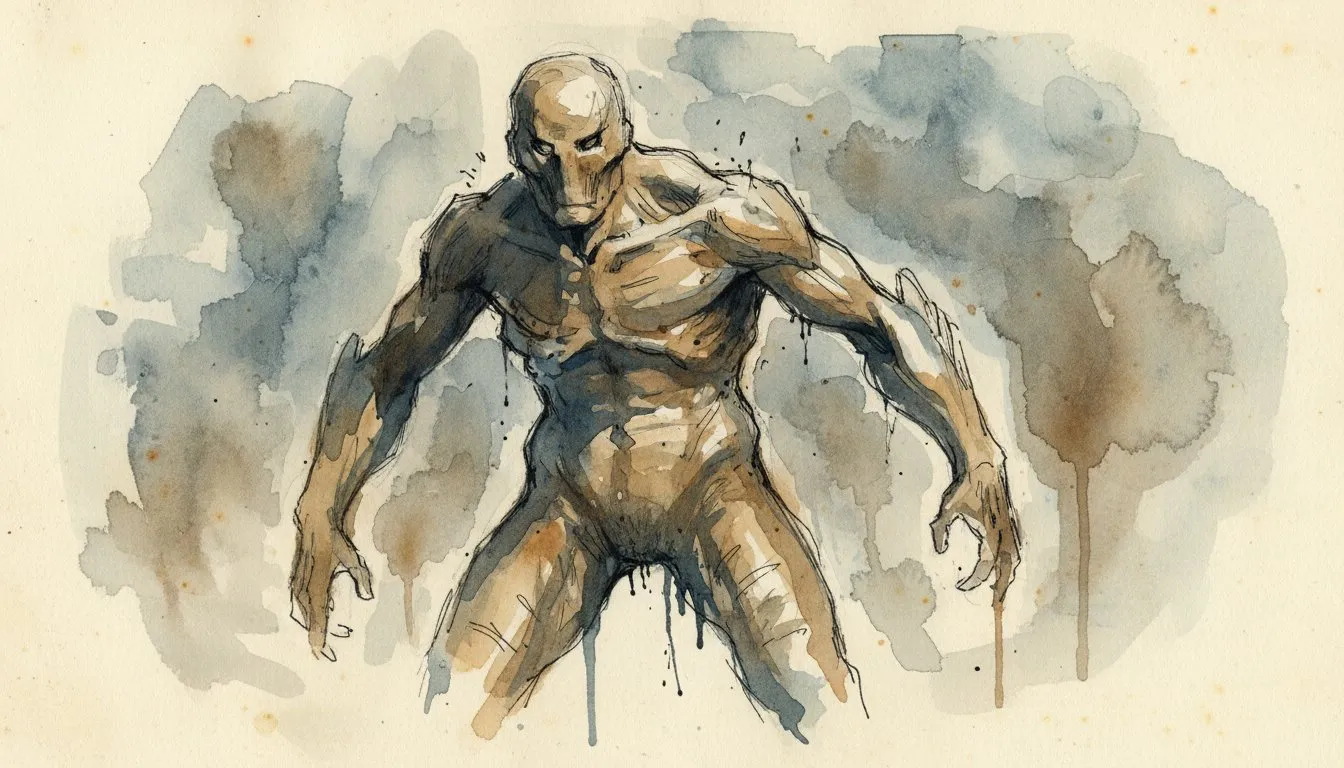
A ghostly white humanoid shape rising from Antarctic waters, seen by Japanese fishermen.
Early 2000s (Japanese forums)
Antarctic and sub-Arctic waters
60-90 ft long (est.)
Passive, observed from distance
Internet legend, unverified
The Lore
The Ningen ('human' in Japanese) is a massive, pale, humanoid sea creature reportedly seen in Antarctic and sub-Arctic waters. Japanese crew members on government research vessels described a smooth, white figure 20-30 meters long with arm-like appendages and a face with minimal features. The story spread through Japanese internet forums in the early 2000s.
The Ningen is one of the first genuinely native cryptids of the internet age, a creature that did not arrive through oral tradition or newspaper sensationalism but through the image boards of early twenty-first century Japan. The name, which simply means human in Japanese, first surfaced on the 2channel forums around 2002 and gained serious momentum by 2007, when anonymous users claiming connections to Japanese Antarctic research vessels posted descriptions and a handful of blurry photographs purporting to show an enormous pale humanoid surfacing through polar ice.
The creature as described is remarkable for its scale and its eerie near-humanity. Witnesses, or those claiming to be, report a smooth-skinned, featureless-faced entity between twenty and thirty meters in length, with recognizable arms, legs, fingers, and sometimes a mermaid-like tail. It is always white, always silent, and always encountered at the edges of human activity, near the bow of a ship, beneath a crack in the ice, or in low-resolution thermal imagery glimpsed for an instant before the camera cuts away. The Japanese Fisheries Agency and the Institute of Cetacean Research, both of which operate in Antarctic waters, have been named in these stories, though no official documentation has ever surfaced.
Cultural critics have noted that the Ningen occupies a specific niche in Japanese horror tradition, drawing on an older fascination with the vast and the uncanny at sea, visible in legends of the umibozu and the bake-kujira, gigantic shapeless beings that menace sailors. What makes the Ningen modern is the medium of its transmission. It spread in the pixelated vernacular of Google Earth captures, grainy phone photographs, and anonymous forum testimony, and its ambiguity is inseparable from the compression artifacts and low-light haze in which it is always depicted.
Most cryptozoologists consider the Ningen a modern legend rather than a candidate species, pointing out the absence of any verifiable photographic source, the biological implausibility of a warm-blooded humanoid in Antarctic waters, and the telltale narrative rhythms of internet creepypasta. What makes the creature culturally significant is not its reality but its method. The Ningen is a case study in how folklore now propagates, assembled collectively by strangers, polished by repetition, and haunting the exact liminal zone, the polar sea seen from orbit, where old monsters once lived.
Further Reading
No book is devoted to this creature. These are the general references that cover the field, plus a direct search if you want to dig further.
- Cryptozoology A to Z by Loren Coleman and Jerome Clark (1999)
The standard one-volume encyclopedia, roughly two hundred entries covering creatures, investigators, and hoaxes.
- Mysterious Creatures: A Guide to Cryptozoology by George M. Eberhart (2002)
The larger reference guide, stronger on sourcing and on creatures that never reached the popular books.
Search Amazon for Ningen books
As an Amazon Associate, Cryptid Vault earns from qualifying purchases. Links open Amazon in a new tab.
Get the Field Notes.
Field notes from the Vault, when there is something worth sending. No spam.
No spam. Unsubscribe anytime.
You might also like
Kraken
The ship-swallowing sea beast of Norse legend, now partially explained by giant squid.
Cadborosaurus
A horse-headed sea serpent weaving through the waters of the Pacific Northwest.
Globster
Massive, fleshy, unidentifiable masses that wash ashore worldwide, defying easy explanation until the lab results come in.
Megalodon
The largest shark that ever lived went extinct 3.6 million years ago, unless the deep ocean is hiding something.
Ri
A marine humanoid reported by fishermen in New Ireland, with a woman's upper body and a fish-like lower half.
Muldjewangk
A colossal water creature in Australia's Murray River that punishes anyone who disturbs its territory with a wasting sickness.

Grafton Monster
A headless, pale giant spotted lumbering through a West Virginia town in 1964.
Morgawr
A humped sea serpent has been spotted off the coast of Cornwall since the 1900s, sometimes close enough to shore that beachgoers scatter.