
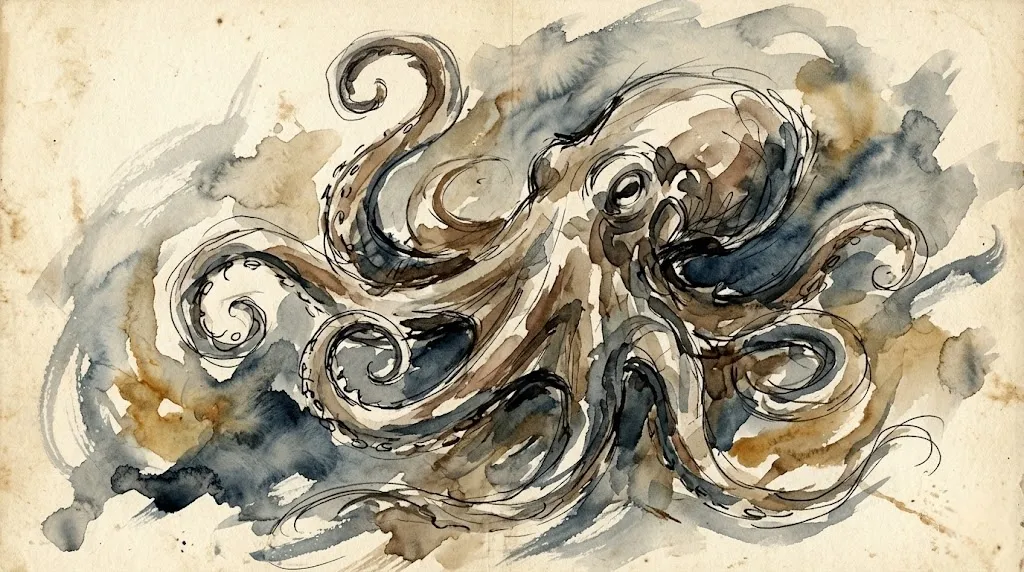
Kraken
Also known as: Sea Monster, Hafgufa
The ship-swallowing sea beast of Norse legend, now partially explained by giant squid.
1180 AD (King Sverre of Norway)
Norwegian Sea, North Atlantic
40-100+ ft (legendary)
Destructive
Partially explained (giant squid)
The Lore
Scandinavian sailors spoke of a creature so vast it was mistaken for islands. The Kraken could drag entire ships beneath the waves. While the giant squid (Architeuthis dux) likely inspired these legends, historical accounts describe something far larger. The Kraken represents the ocean's capacity to terrify even the bravest sailors.
Sailors in the North Atlantic have told stories of a massive sea creature capable of dragging ships beneath the waves for at least a thousand years. Norse sagas from the 13th century describe the Kraken as an island-sized beast lurking off the coasts of Norway and Iceland. The creature was said to create dangerous whirlpools when it submerged and could pull entire vessels down with its enormous arms.
The first detailed scientific description came from Erik Pontoppidan, the Bishop of Bergen, Norway, who included the Kraken in his 1752 work "The Natural History of Norway." Pontoppidan described a creature so large that it could be mistaken for a series of small islands. He recorded fishermen's accounts of hauling up enormous quantities of fish above the Kraken's resting place, suggesting it attracted prey. Carolus Linnaeus, the father of modern taxonomy, initially included the Kraken in his 1735 edition of "Systema Naturae" as a cephalopod, though he removed it from later editions.
The mystery of the Kraken began to resolve in the 19th century when giant squid specimens started washing ashore. In 1853, a giant squid beak was recovered from the stomach of a sperm whale, proving the existence of enormous cephalopods. In 1873, two fishermen off the coast of Newfoundland reportedly fought off a giant squid that grabbed their boat, cutting off one of its tentacles with a hatchet. The severed tentacle measured 19 feet. Throughout the late 1800s, multiple giant squid carcasses washed up on beaches in Newfoundland and Norway, some measuring 40 feet or more.
The giant squid (Architeuthis dux) is now recognized as a real animal that can reach lengths of 43 feet or more. Its even larger relative, the colossal squid (Mesonychoteuthis hamiltoni), can grow to at least 46 feet and possesses rotating hooks on its tentacles. The first live giant squid was filmed in its natural deep-sea habitat by Japanese researchers Tsunemi Kubodera and Kyoichi Mori in 2004, at a depth of 2,950 feet.
While the discovery of giant and colossal squid has provided a plausible biological basis for Kraken legends, some cryptozoologists argue that even larger, undiscovered cephalopods may exist in the deep ocean. Sucker marks found on sperm whales have occasionally measured larger than those attributable to known squid species. Whether the Kraken of legend was simply an early encounter with giant squid or something more remains an open question.
Notable Witnesses
- Erik Pontoppidan (Bishop of Bergen, 1752 account)
- Pierre Denys de Montfort (naturalist, 1801)
- Theophile and Tom Piccot (Newfoundland fishermen, 1873)
- Reverend Moses Harvey (preserved specimen, 1874)
Media Appearances
- Twenty Thousand Leagues Under the Sea by Jules Verne (1870)
- Pirates of the Caribbean: Dead Man's Chest (2006)
- Clash of the Titans (2010)
- Beast (2022)
- Kraken: Tentacles of the Deep (2006)
- Sea of Thieves (video game, 2018)
Further Reading
The kraken is the rare case where the legend led somewhere real. In 1857 the Danish zoologist Japetus Steenstrup connected the sea-monster accounts to physical specimens and named Architeuthis dux, the giant squid. The useful books here are marine biology, not cryptozoology.
- The Search for the Giant Squid by Richard Ellis (1998)
The definitive account, and the one that takes the mythology as seriously as the biology. Ellis covers the taxonomy, the historical sightings and the long gap between the legend and the specimen.
- Kraken: The Curious, Exciting, and Slightly Disturbing Science of Squid by Wendy Williams (2011)
Broader and livelier: the wider science of squid and cephalopods, including how they camouflage and why they are so hard to observe alive.
Search Amazon for giant squid Architeuthis books
As an Amazon Associate, Cryptid Vault earns from qualifying purchases. Links open Amazon in a new tab.
Get the Field Notes.
Field notes from the Vault, when there is something worth sending. No spam.
No spam. Unsubscribe anytime.
You might also like
Loch Ness Monster
The legendary lake serpent of Scotland, photographed, sonar-scanned, and never found.
Cadborosaurus
A horse-headed sea serpent weaving through the waters of the Pacific Northwest.

Ningen
A ghostly white humanoid shape rising from Antarctic waters, seen by Japanese fishermen.

Globster
Massive, fleshy, unidentifiable masses that wash ashore worldwide, defying easy explanation until the lab results come in.
Morgawr
A humped sea serpent has been spotted off the coast of Cornwall since the 1900s, sometimes close enough to shore that beachgoers scatter.
Megalodon
The largest shark that ever lived went extinct 3.6 million years ago, unless the deep ocean is hiding something.
Trunko
A massive white carcass with an elephant-like trunk that washed ashore in South Africa.
Nuckelavee
A skinless horse-rider hybrid rises from the ocean around Orkney, and its breath alone can wilt crops and sicken entire islands.