
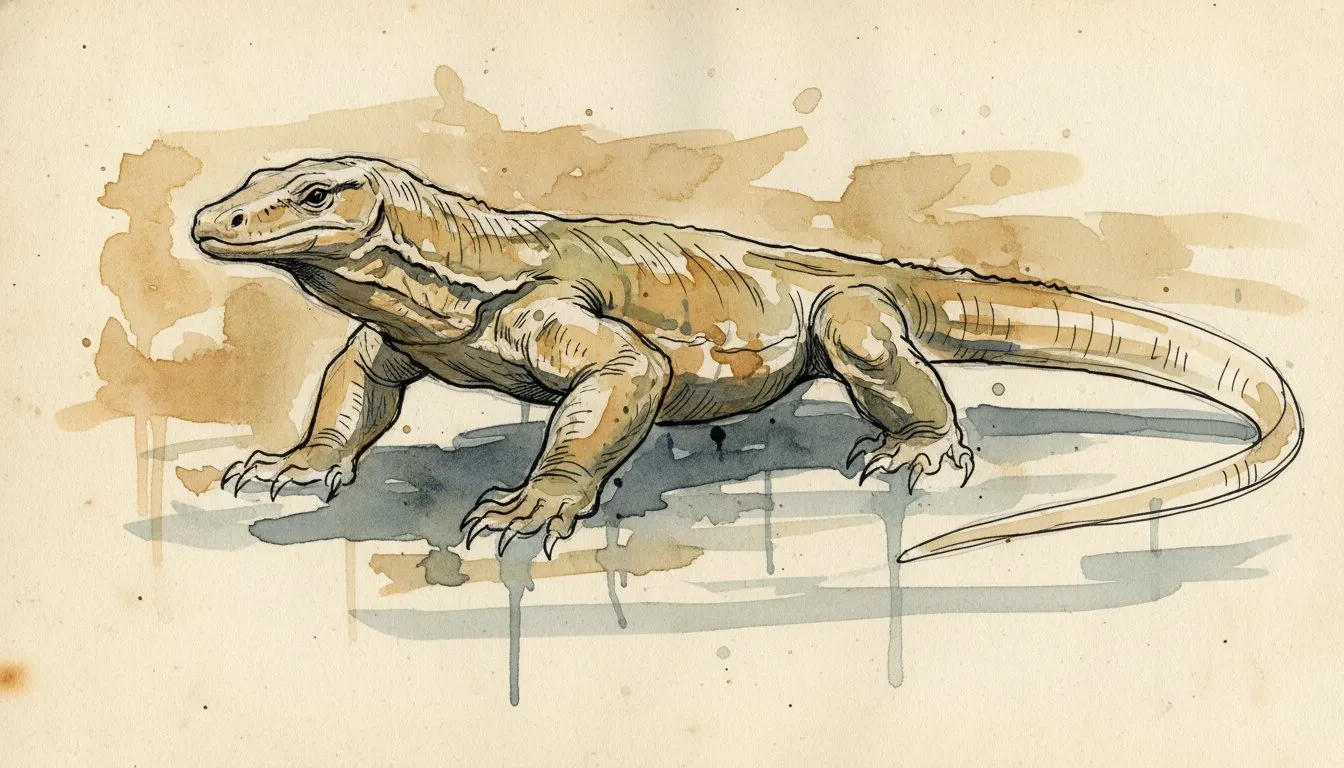
Buru
A giant aquatic lizard once said to inhabit remote Himalayan valleys before being deliberately exterminated.
Apatani oral tradition, investigated 1948
Ziro Valley, Arunachal Pradesh, India
3-4 meters long
Semi-aquatic, territorial
Believed exterminated by Apatani people
The Lore
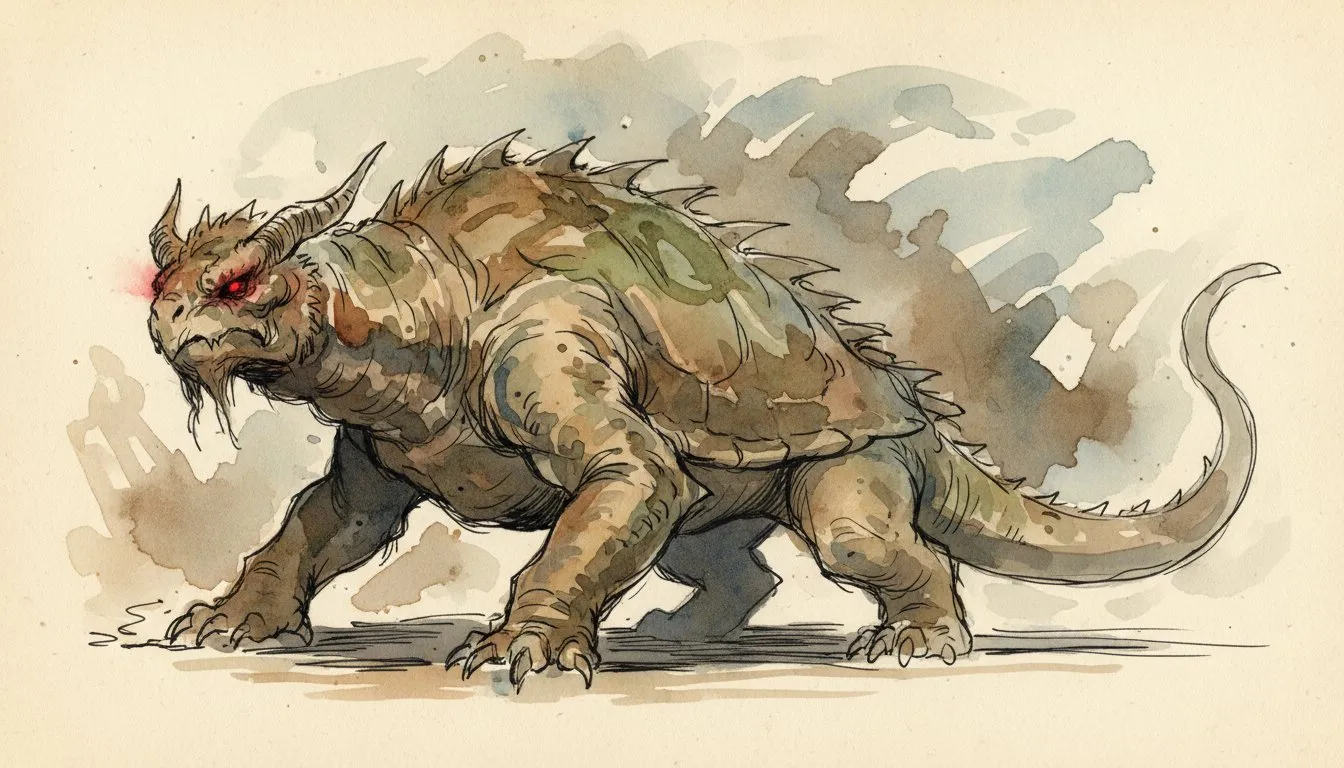
The buru is a cryptid described by the Apatani people of Ziro Valley in Arunachal Pradesh, India, as a large, elongated aquatic lizard. According to oral histories, the buru lived in swampy areas of the valley before the Apatani drained the marshes and killed the creatures generations ago. British explorer Charles Stonor investigated in 1948 and recorded consistent descriptions from elders who had never seen the animal themselves but preserved detailed accounts. Some researchers suggest the buru may have been a surviving population of large monitor lizards or an unknown crocodilian.
In the valleys of the Apa Tani plateau in what is now the Indian state of Arunachal Pradesh, a series of events in the late 1940s briefly placed an obscure local legend at the center of serious scientific attention. The Apa Tani people, an indigenous group inhabiting the high valleys of the eastern Himalayan foothills, preserved a tradition describing a large aquatic animal called the Buru that had formerly inhabited the swampy marsh at the floor of their main valley. According to oral tradition, the Buru had been present in the valley when Apa Tani ancestors first settled it, and the process of draining the marsh for agricultural use over many generations had forced the creatures out. Elders described how the Buru had been driven away or killed as the wet ground was converted to paddy fields, and some accounts suggested that attempts to drive them from their mud burrows had been made within living memory.
The Buru was described in considerable detail. It was said to be approximately twelve to fifteen feet in length, with a long neck and a large, elongated head bearing three rows of teeth. The body was heavy and low-slung, with four short, powerful limbs. The skin was described as a dull blue or mottled color. The creature was reported to be primarily aquatic, spending most of its time submerged and surfacing periodically to breathe, emitting a bellowing sound when disturbed. The Apa Tani description, collected by anthropologist Christoph von Furer-Haimendorf in 1944, was specific and consistent across multiple informants.
A formal expedition in 1948 by Charles Stonor and Ralph Izzard, accompanied by von Furer-Haimendorf, excavated areas identified by Apa Tani elders as former Buru habitat but found no physical remains. The local terrain had changed substantially through generations of agricultural development, and the team concluded that if the Buru had existed, it had been driven to extinction or displacement before any physical evidence could be preserved. Stonor later proposed that the Buru most closely resembled a large, unknown monitor lizard or an aquatic reptile of uncertain affinity.
The Buru remains one of the more intriguing cryptids in the South Asian record because the mechanism of its reported disappearance - human agricultural expansion eliminating a wetland habitat - is ecologically plausible, and because the tradition was collected by trained anthropologists from communities with no apparent motive for fabrication. If the Buru was real, it was most likely a large reptile extirpated from the Apa Tani valley before science had the opportunity to examine it.
Notable Witnesses
- Charles Stonor (British explorer, 1948)
- Ralph Izzard (Daily Mail correspondent)
Further Reading
No book is devoted to this creature. These are the general references that cover the field, plus a direct search if you want to dig further.
- Cryptozoology A to Z by Loren Coleman and Jerome Clark (1999)
The standard one-volume encyclopedia, roughly two hundred entries covering creatures, investigators, and hoaxes.
- Mysterious Creatures: A Guide to Cryptozoology by George M. Eberhart (2002)
The larger reference guide, stronger on sourcing and on creatures that never reached the popular books.
As an Amazon Associate, Cryptid Vault earns from qualifying purchases. Links open Amazon in a new tab.
Get the Field Notes.
Field notes from the Vault, when there is something worth sending. No spam.
No spam. Unsubscribe anytime.
You might also like
Con Rit
A segmented, armored sea creature with dozens of lateral fins, washed ashore in Vietnam in 1883.
Kirin
A divine chimera of dragon and deer that only appears to herald greatness or disaster.
Yeren
China's Bigfoot roams the thick forests of Hubei Province, backed by thousands of reported sightings.
Dingonek
A saber-toothed, armored aquatic predator was reported in a Kenyan river by a big-game hunter in 1907.
Chipfalamfula
In Zambian lakes, a massive horned beast surfaces with enough force to capsize fishing boats.
Kappa
Japan's mischievous water imp with a bowl of power on its head.
Altamaha-ha
Georgia's river serpent, a long-necked mystery lurking in the murky Altamaha.
Beast of Busco
A giant snapping turtle the size of a dining table, spotted in an Indiana farm pond.