
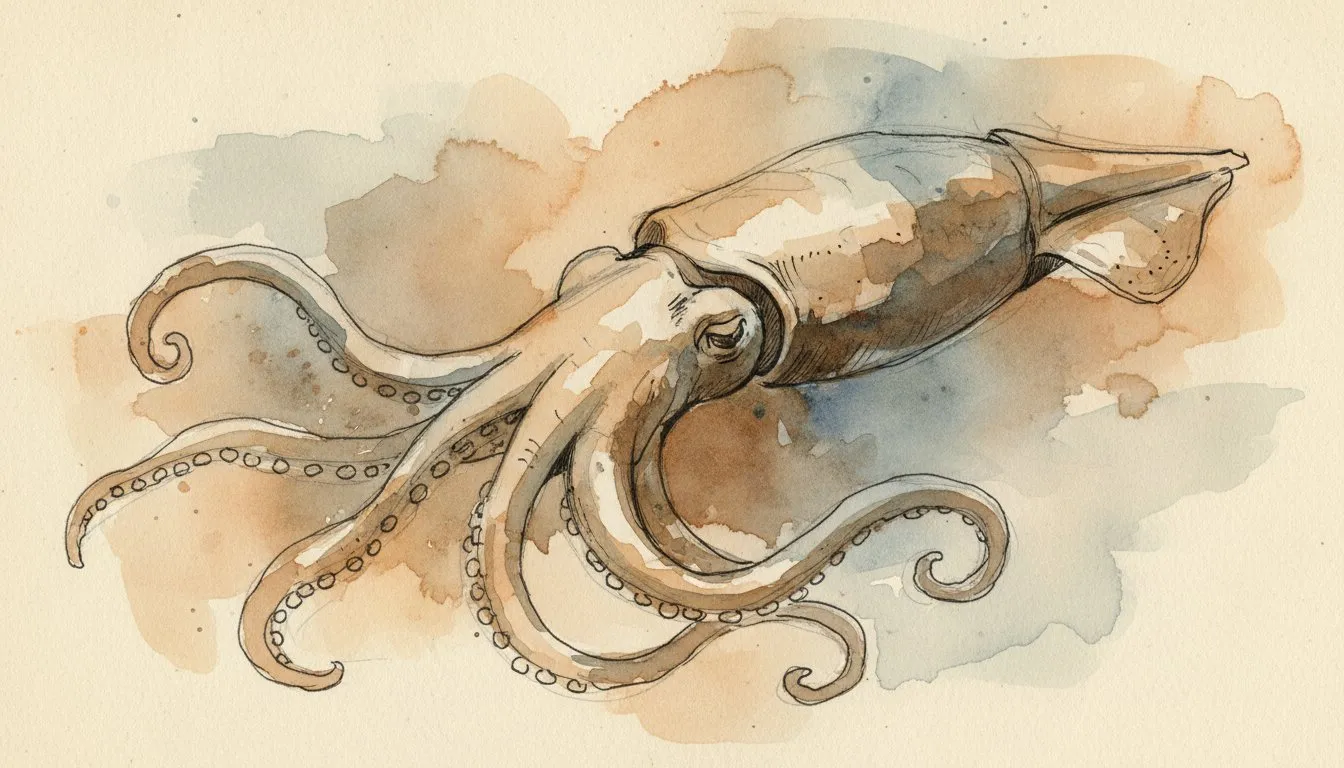
Con Rit
Also known as: Centipede Whale, Many-finned Sea Serpent
A segmented, armored sea creature with dozens of lateral fins, washed ashore in Vietnam in 1883.
1883 (Hongay carcass)
Gulf of Tonkin, Vietnam
Approximately 18 meters long
Unknown
No modern sightings, historical carcass account
The Lore
The con rit is a cryptid sea creature reported in the waters off Vietnam, described as an enormous segmented animal resembling a centipede or armored worm. In 1883, a carcass allegedly washed ashore at Hongay, measuring about 18 meters long with segmented, armored plates and lateral fins along its body. Dr. A. Krempf of the Oceanographic and Fisheries Service of Indo-China interviewed a witness in 1921 who confirmed the account. Some cryptozoologists have linked it to ancient, armored prehistoric marine arthropods.
Along the coastal waters of Vietnam and the broader Gulf of Tonkin, mariners and fishing communities have preserved accounts of an enormous sea creature of extraordinary and unusual morphology. The Con Rit - whose name translates roughly as "millipede" or "centipede" in Vietnamese - is described not as a serpentine sea monster of the conventional kind but as a segmented creature, each ring of its body separated by a visible joint, with numerous fins or appendages projecting from the sides. Reported lengths have ranged from sixty to two hundred feet, and the creature is said to move through the water with a lateral undulation, the segments rippling in sequence as it swims.
The most significant historical account comes from 1883, when a large carcass reportedly washed ashore near Hongay in northern Vietnam. Local witnesses described a body approximately sixty feet long, with a structure clearly composed of distinct segments, each approximately two feet wide, with a series of reddish-brown fins along the sides. The creature was said to smell powerfully of decomposition. No scientist examined the carcass before it was pulled back into the sea by the tide, and the account rests on the testimony of those who were present. A second report from the early twentieth century described a living Con Rit encountered by a fisherman named Tran Van Con near the island of Bich Kich, who claimed the creature passed beneath his boat and generated a powerful underwater wake.
Cryptozoologists have proposed several biological candidates for the Con Rit. The most frequently cited is a dramatically scaled-up polychaete worm - the segmented marine worms that include the giant tube worm and the predatory Bobbit worm - though no known polychaete approaches anything near the reported dimensions. Others have suggested a surviving arthropod of unusual form, invoking the extinct giant sea scorpions of the Paleozoic era. More conservative researchers have proposed that witnesses may have encountered a line of connected cuttlefish or squid, or an enormous oarfish viewed from an unusual angle - the oarfish does have a segmented appearance along its dorsal fin.
The Con Rit occupies a distinctive position in sea monster traditions because its segmented, arthropod-like morphology sets it apart from the serpentine or plesiosaur-like creatures most commonly reported in other oceanic traditions. Whether it represents a genuine biological anomaly or an imaginative elaboration of more ordinary encounters remains unresolved.
Notable Witnesses
- Dr. A. Krempf (interviewed witnesses in 1921)
- Tran Van Con (1883 witness)
Further Reading
No book is devoted to this creature. These are the general references that cover the field, plus a direct search if you want to dig further.
- Cryptozoology A to Z by Loren Coleman and Jerome Clark (1999)
The standard one-volume encyclopedia, roughly two hundred entries covering creatures, investigators, and hoaxes.
- Mysterious Creatures: A Guide to Cryptozoology by George M. Eberhart (2002)
The larger reference guide, stronger on sourcing and on creatures that never reached the popular books.
Search Amazon for Con Rit books
As an Amazon Associate, Cryptid Vault earns from qualifying purchases. Links open Amazon in a new tab.
Get the Field Notes.
Field notes from the Vault, when there is something worth sending. No spam.
No spam. Unsubscribe anytime.
You might also like
Megalodon
The largest shark that ever lived went extinct 3.6 million years ago, unless the deep ocean is hiding something.
Akkorokamui
A colossal red octopus lurking in Funka Bay, revered by the Ainu as both healer and destroyer.
Globster
Massive, fleshy, unidentifiable masses that wash ashore worldwide, defying easy explanation until the lab results come in.
Batutut
A bipedal ape spotted by both Vietnamese villagers and American soldiers during the war.
Nguoi Rung
Deep in Vietnam's jungles, soldiers and scientists have reported a powerfully built ape that walks like a man.
Cadborosaurus
A horse-headed sea serpent weaving through the waters of the Pacific Northwest.
Issie
Japan's answer to Nessie lives in a volcanic crater lake on the southern tip of Kyushu.
Jorogumo
A 400-year-old spider that takes the form of a beautiful woman to lure men to their death.