
Adze
Also known as: Firefly Vampire
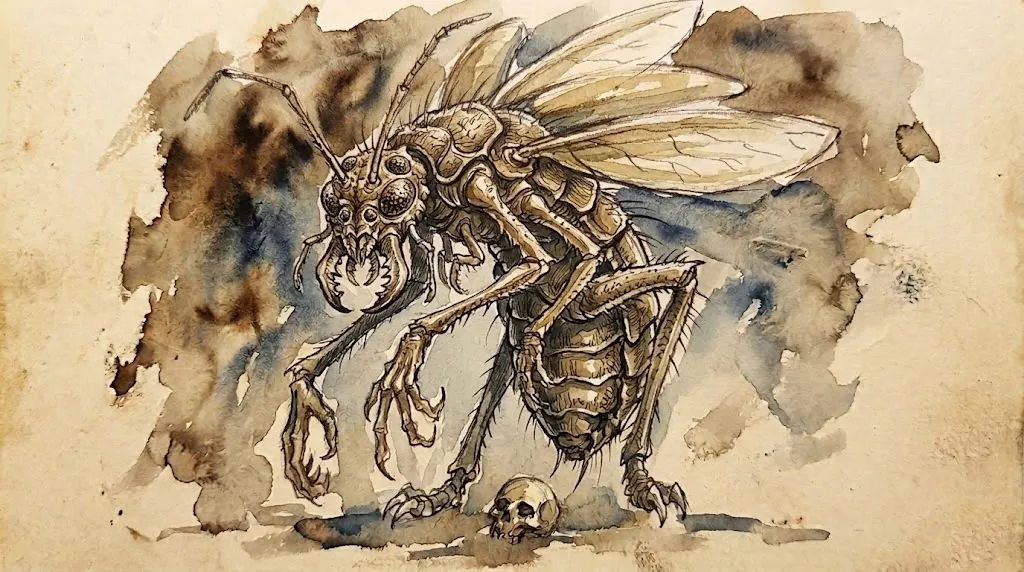
In Togo, a vampire disguised as a glowing firefly slips through locked doors to feed on the sleeping.
Ancient Ewe oral tradition
Togo and Ghana
Firefly-sized to human-sized
Predatory and cunning
Folklore
The Lore
The Adze is a vampiric entity from the Ewe people of Togo and Ghana. In its natural form, it appears as a glowing firefly that can pass through any closed door or window. Once inside a home, it transforms into a humanoid to feed on its victim's blood, particularly targeting children. If captured in firefly form, it reverts to human shape and can be identified as a possessed villager. Communities sometimes conducted witch hunts to find the person harboring the Adze.
The Adze is the vampire of the Ewe people of Ghana and Togo, and like the European vampire tradition that superficially resembles it, the Adze operates at the intersection of disease, community cohesion, and the terrifying unpredictability of death. The creature is described as taking the form of a firefly in its most active state, drifting through villages at night and passing through walls and closed doors to reach sleeping victims. It feeds on blood, palms oil, and coconut water, and it is said to prefer the blood of children. A victim repeatedly visited by an Adze is expected to fall ill and die - a framework that would have mapped efficiently onto the experience of malaria in a pre-medical context, given that malaria is transmitted by mosquitoes attracted to warmth and that its victims, particularly children, decline progressively over repeated bouts.
The most distinctive feature of the Adze tradition is what happens when the creature is caught. An Adze that is captured in its firefly form reverts to its true form - a hunchbacked human being, possessed of supernatural powers but visibly a person rather than an animal. This transformation is critical to the legend's social function. The Adze, in human form, is a witch - a member of the community who has chosen to use occult power to harm their neighbors. The person revealed as an Adze practitioner faces the community's judgment, and the tradition therefore provides a supernatural explanation for community conflict, illness, and misfortune that locates the source of harm within the social group rather than in external nature.
Ewe ritual practice has historically included protective measures against the Adze, with certain plant materials, charms, and ritual specialists employed to safeguard vulnerable households. These protections were particularly focused on children and on pregnant women, reflecting the known demographic targets of malaria in tropical West Africa. The overlay between the Adze's behavior and the biology of malaria transmission - nocturnal, blood-feeding, preference for children, association with water sources - is close enough that some scholars have proposed the legend represents an indigenous epidemiological model encoded in supernatural language.
The Adze tradition remains active in parts of Ghana and Togo, where it coexists with Christian and medical frameworks for explaining disease. Its persistence reflects the way deeply rooted explanatory models survive not because they are resistant to alternatives but because they carry social functions - community solidarity, moral accountability, the management of fear - that alternative frameworks do not fully replace.
Further Reading
No book is devoted to this creature. These are the general references that cover the field, plus a direct search if you want to dig further.
- Cryptozoology A to Z by Loren Coleman and Jerome Clark (1999)
The standard one-volume encyclopedia, roughly two hundred entries covering creatures, investigators, and hoaxes.
- Mysterious Creatures: A Guide to Cryptozoology by George M. Eberhart (2002)
The larger reference guide, stronger on sourcing and on creatures that never reached the popular books.
As an Amazon Associate, Cryptid Vault earns from qualifying purchases. Links open Amazon in a new tab.
Get the Field Notes.
Field notes from the Vault, when there is something worth sending. No spam.
No spam. Unsubscribe anytime.
You might also like
Popobawa
Zanzibar's most feared entity attacks at night and demands that victims tell others, or it returns.
Sasabonsam
In the forests of Ghana, something with iron teeth and bat wings sits in the treetops, legs dangling like bait.
Boto
The Amazon's pink river dolphin comes ashore at night disguised as a handsome stranger.
Aswang
The Philippines' most feared shapeshifter hides as your neighbor by day and hunts as a beast by night.
Peuchen
A shapeshifting flying serpent from Chilean forests that drains the blood of livestock from the air.
Jorogumo
A 400-year-old spider that takes the form of a beautiful woman to lure men to their death.
Manananggal
A vampire that tears its own torso free and flies through the night on bat-like wings, trailing its entrails below.
Each-Uisge
This shape-shifting water horse of Scottish lochs lures riders onto its back, then drags them to a watery death.