
Black Shuck
Also known as: Old Shuck, Shuck, Galleytrot
A ghostly black dog with blazing red eyes has haunted the roads and churchyards of East Anglia for over a thousand years.
1127 (Peterborough Chronicle)
East Anglia, England
Calf-sized to horse-sized, varies by account
Terrifying, sometimes violent
Modern sightings still reported
The Lore
Black Shuck is a phantom black dog reported across Norfolk, Suffolk, and Essex in eastern England. The most famous encounter occurred on August 4, 1577, when a black dog reportedly burst through the doors of Holy Trinity Church in Blythburgh during a thunderstorm, killing two worshippers and leaving scorch marks on the church door that remain visible today. Sightings of a spectral black hound continue along lonely roads and coastal paths throughout East Anglia.
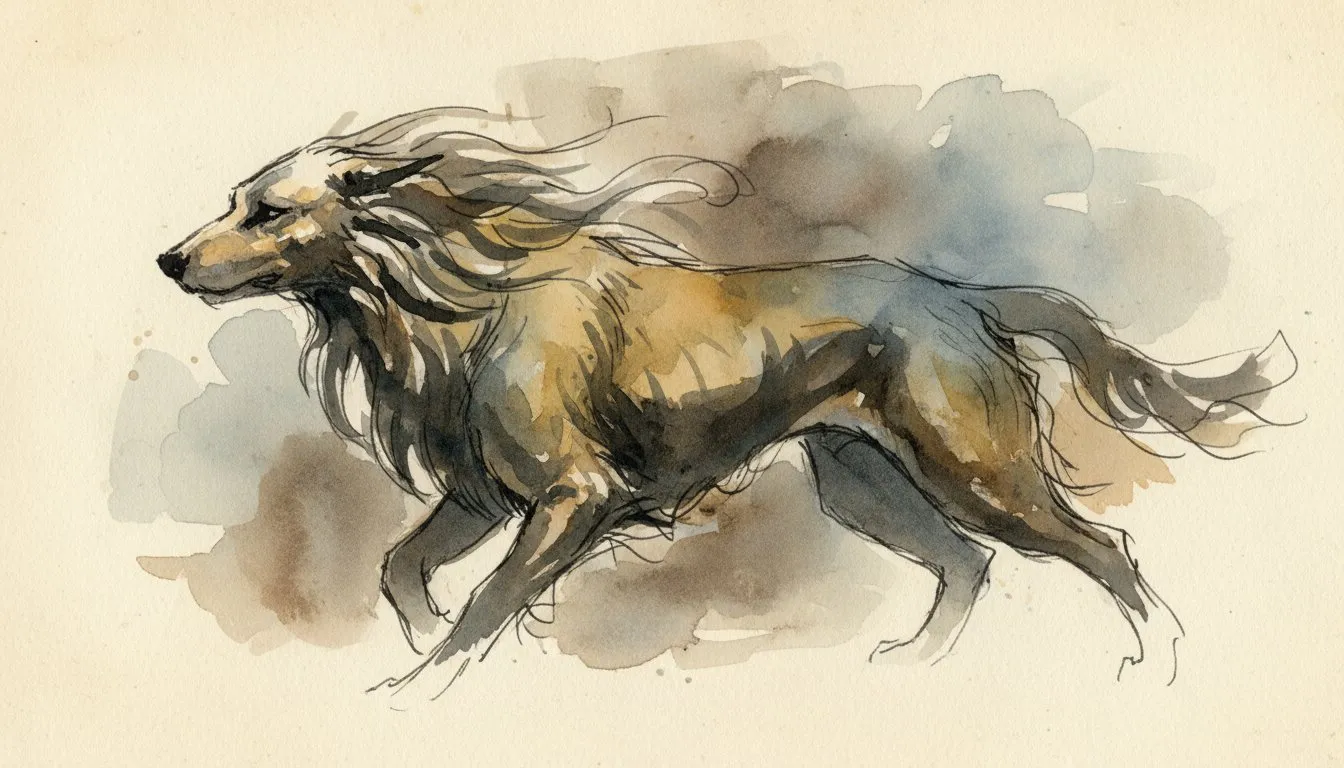
Black Shuck is the most famous of the English phantom black dogs, a class of spectral canine that haunts the folklore of nearly every English county but finds its densest concentration in East Anglia. The name likely comes from the Old English scucca, meaning demon or devil, and reports of the creature date back to at least the 12th century. Descriptions are consistent across centuries: a dog the size of a calf or a small horse, shaggy black fur, and eyes that glow red or sometimes a single eye in the center of its forehead. It appears on lonely roads, in churchyards, and along the coastal paths at dusk, and in most traditions seeing it is an omen of death within the year.
The most infamous incident occurred on August 4, 1577, in the Suffolk village of Blythburgh. During a violent thunderstorm, a black dog was said to have burst through the doors of Holy Trinity Church during Sunday service, run down the nave, killed a man and a boy, and caused the church steeple to collapse through the roof. On the same day, a nearly identical event was reported at St Mary's Church in Bungay, twelve miles away, chronicled in a pamphlet by the clergyman Abraham Fleming titled A Straunge and Terrible Wunder. Scorch marks on the north door of Blythburgh church, visible to this day, are locally attributed to the creature's claws. Modern analysis suggests lightning strike as the more probable cause, but the marks remain a tourist draw and the story has never loosened its grip on the parish.
Black Shuck sightings continued through the 19th and 20th centuries, particularly along the Norfolk coast between Sheringham and Overstrand, an area so associated with the creature it was sometimes called Shuck's Lane. Arthur Conan Doyle visited the nearby village of Cromer in 1901 and heard local stories of a spectral hound haunting the estate of a local family. He began writing The Hound of the Baskervilles within months, transposing the setting to Dartmoor but borrowing the East Anglian dog in spirit if not in name.
In 2014, archaeologists excavating the ruins of Leiston Abbey in Suffolk unearthed the skeleton of an enormous dog, roughly seven feet long and estimated to have weighed around 200 pounds when alive, buried in a shallow grave dating to roughly the period of the 1577 incidents. The find was widely reported as the possible bones of Black Shuck, though the skeleton was more likely a medieval mastiff or wolfhound. Whatever its identity, the discovery reinforced how deeply the creature is knitted into the landscape of eastern England, a dog whose footprints refuse to fade.
Notable Witnesses
- Worshippers at Blythburgh Church (1577)
- Worshippers at St Mary's Bungay (1577)
Media Appearances
- The Hound of the Baskervilles (inspiration)
- Assassin's Creed Valhalla
Further Reading
No book is devoted to this creature. These are the general references that cover the field, plus a direct search if you want to dig further.
- Cryptozoology A to Z by Loren Coleman and Jerome Clark (1999)
The standard one-volume encyclopedia, roughly two hundred entries covering creatures, investigators, and hoaxes.
- Mysterious Creatures: A Guide to Cryptozoology by George M. Eberhart (2002)
The larger reference guide, stronger on sourcing and on creatures that never reached the popular books.
Search Amazon for Black Shuck books
As an Amazon Associate, Cryptid Vault earns from qualifying purchases. Links open Amazon in a new tab.
Get the Field Notes.
Field notes from the Vault, when there is something worth sending. No spam.
No spam. Unsubscribe anytime.
You might also like
Cu-Sith
A massive dark green hound the size of a bull roams the Scottish Highlands, and hearing its third bark means death.
Beast of Gevaudan
A massive wolf-like predator terrorized rural France for three years, killing over 100 people before it was finally brought down.
Spring-Heeled Jack
A cloaked figure with clawed hands and blazing eyes leapt over walls and breathed blue flame across Victorian England.
Owlman
A towering owl-humanoid haunting the woods around a Cornish church.
Beast of Bodmin Moor
A large black cat prowls the foggy moors of Cornwall, shredding livestock and vanishing into the granite landscape.
Beast of Dartmoor
Something large, dark, and feline stalks the misty moorlands of Devon, leaving torn livestock and fleeting glimpses behind.
Morgawr
A humped sea serpent has been spotted off the coast of Cornwall since the 1900s, sometimes close enough to shore that beachgoers scatter.
Beast of Bray Road
A shaggy, upright canine prowling a rural Wisconsin road since the 1980s.