
Chessie
Also known as: Chesapeake Bay Sea Monster, Chesapeake Bay Serpent
A serpentine creature reported in the Chesapeake Bay for half a century, caught on video in 1982.
Scattered 20th-century accounts; surge from the 1970s
Chesapeake Bay, Maryland/Virginia
25-40 ft long (est.)
Elusive, non-aggressive
Unconfirmed; most reported in summer
The Lore
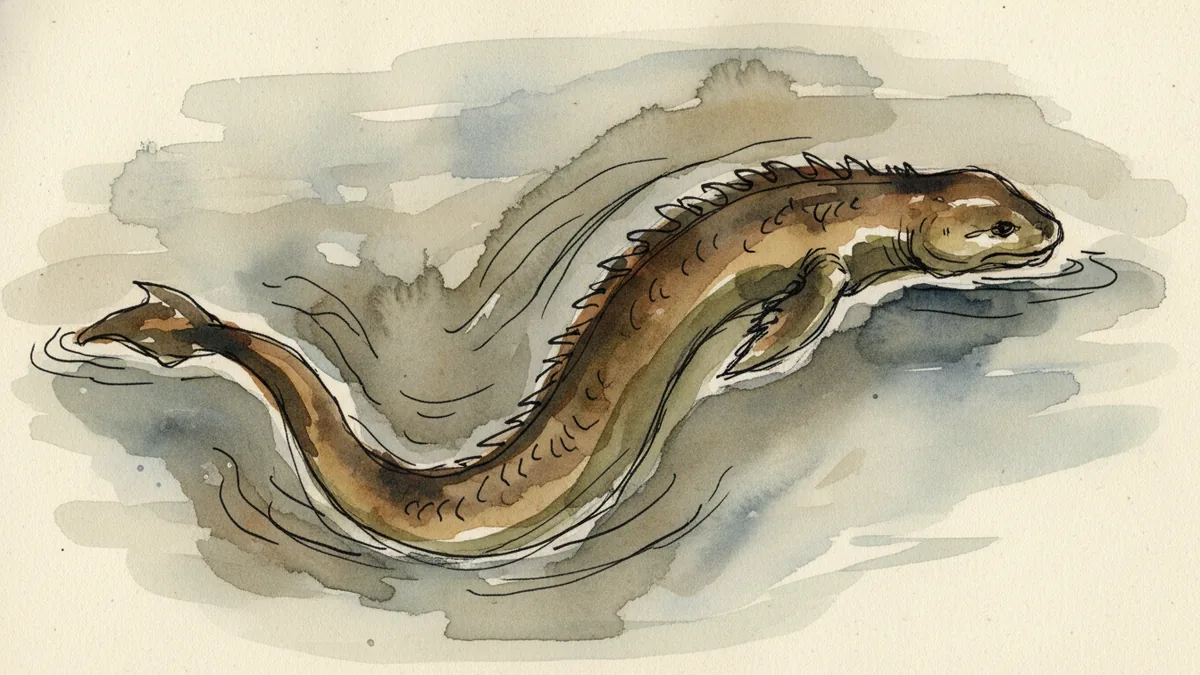
Chessie is the serpent-like cryptid reported in the Chesapeake Bay, the largest estuary in the United States. Witnesses describe a dark, 25-to-40-foot snake-like animal that moves with vertical undulations and shows no visible fins. The most famous evidence is a 1982 home video shot by Robert Frew near Kent Island, Maryland, which a panel including Smithsonian scientists reviewed and could neither identify nor dismiss. Reports concentrate sharply in the summer boating months.
The Chesapeake Bay is the largest estuary in the United States, stretching roughly 200 miles from the mouth of the Susquehanna River in Maryland to the Atlantic Ocean off Virginia, fed by more than 150 rivers and creeks across a 64,000-square-mile watershed. It is shallow for its size, averaging only about 21 feet deep, but it is also enormous, biologically rich, and heavily trafficked. Into that water people have, for at least half a century, reported a long, dark, serpentine animal that does not match anything in the bay's known catalog of fish and marine life. It is called Chessie, a deliberate echo of Scotland's Nessie, and unlike many cryptids it has a body of eyewitness accounts drawn largely from watermen, recreational boaters, and waterfront residents who spend their lives looking at this particular water.
Witness descriptions are unusually consistent. Chessie is typically reported as 25 to 40 feet long, dark in color, as thick around as a telephone pole or a human torso, and snake-like, with a head often compared to a football or a basketball. Observers describe it moving through vertical undulations, humping up and down rather than side to side, and almost no one reports seeing fins, flippers, or limbs. Sightings cluster in the warm months and along the bay's main stem and tidal river mouths, particularly around the Maryland eastern shore, the Potomac, and the waters near the Bay Bridge. Scattered accounts go back into the early and mid-20th century, but the named Chessie phenomenon took shape during a wave of reports in the 1970s.
The single most important piece of evidence appeared in May 1982. Robert and Karen Frew, hosting guests at their home overlooking the bay near Love Point on Kent Island, Maryland, used a home video camera to film a long, dark object moving through the water perhaps several hundred feet offshore. The resulting footage, a few minutes long, shows a submerged serpentine shape surfacing and diving. Through researcher Mike Frizzell and his Enigma Project, the tape was brought to a 1982 meeting at the Smithsonian Institution, where scientists and image analysts reviewed it frame by frame. Their conclusion was carefully inconclusive: the footage clearly showed something animate and substantial, but the image was not sharp enough to identify a species, and they could neither confirm an unknown animal nor demonstrate a hoax. That non-dismissal, from credentialed institutional scientists, is part of why Chessie is taken more seriously than many regional water monsters.
Skeptics have natural candidates. The Atlantic sturgeon, a primitive armored fish that can exceed 14 feet, was historically abundant in the bay, surfaces and rolls in ways that can look reptilian, and had become rare enough by the late 20th century that a large one would be both unfamiliar and startling to most witnesses. Large eels, swimming deer or otters in a line, floating debris, and escaped exotic snakes have all been proposed. Adding to the confusion, a real West Indian manatee that wandered far up the bay in 1994 and was tracked north to New England was also nicknamed Chessie, a separate and well-documented animal that shares only the name. None of these explanations has closed the case, and the bay continues to generate new reports each summer, when the most people are on the water with the most chances to see whatever is out there.
Further Reading
Chessie never drew Champ's tabloid crowds, but it got something rarer: a university-press cultural history, written after the sightings settled.
- Chessie: A Cultural History of the Chesapeake Bay Sea Monster by Eric A. Cheezum (2024)
Cheezum follows the Bay sightings from the 1978 Potomac reports through the 1982 Kent Island video, and reads the monster against the Chesapeake's own environmental story.
- The Untold Story of Champ: A Social History of America's Loch Ness Monster by Robert E. Bartholomew (2012)
The closest companion study: how America's other famous water monster was made, told with the same historian's tools.
Search Amazon for Chessie Chesapeake Bay sea monster books
As an Amazon Associate, Cryptid Vault earns from qualifying purchases. Links open Amazon in a new tab.
Get the Field Notes.
Field notes from the Vault, when there is something worth sending. No spam.
No spam. Unsubscribe anytime.
You might also like

Champ
America's own lake monster, surfacing in the waters between Vermont and New York.
Loch Ness Monster
The legendary lake serpent of Scotland, photographed, sonar-scanned, and never found.
Cadborosaurus
A horse-headed sea serpent weaving through the waters of the Pacific Northwest.
Gloucester Sea Serpent
Hundreds of witnesses watched a giant serpent patrol Gloucester Harbor for weeks in 1817.
Altamaha-ha
Georgia's river serpent, a long-necked mystery lurking in the murky Altamaha.
Manipogo
Lake Manitoba's serpentine lake monster has been reported by Indigenous communities for centuries and photographed at least twice.
White River Monster
An enormous gray creature that churned the White River and earned state legal protection.
Alkali Lake Monster
A 40-foot beast in a shallow Nebraska lake, where something that size should have nowhere to hide.