
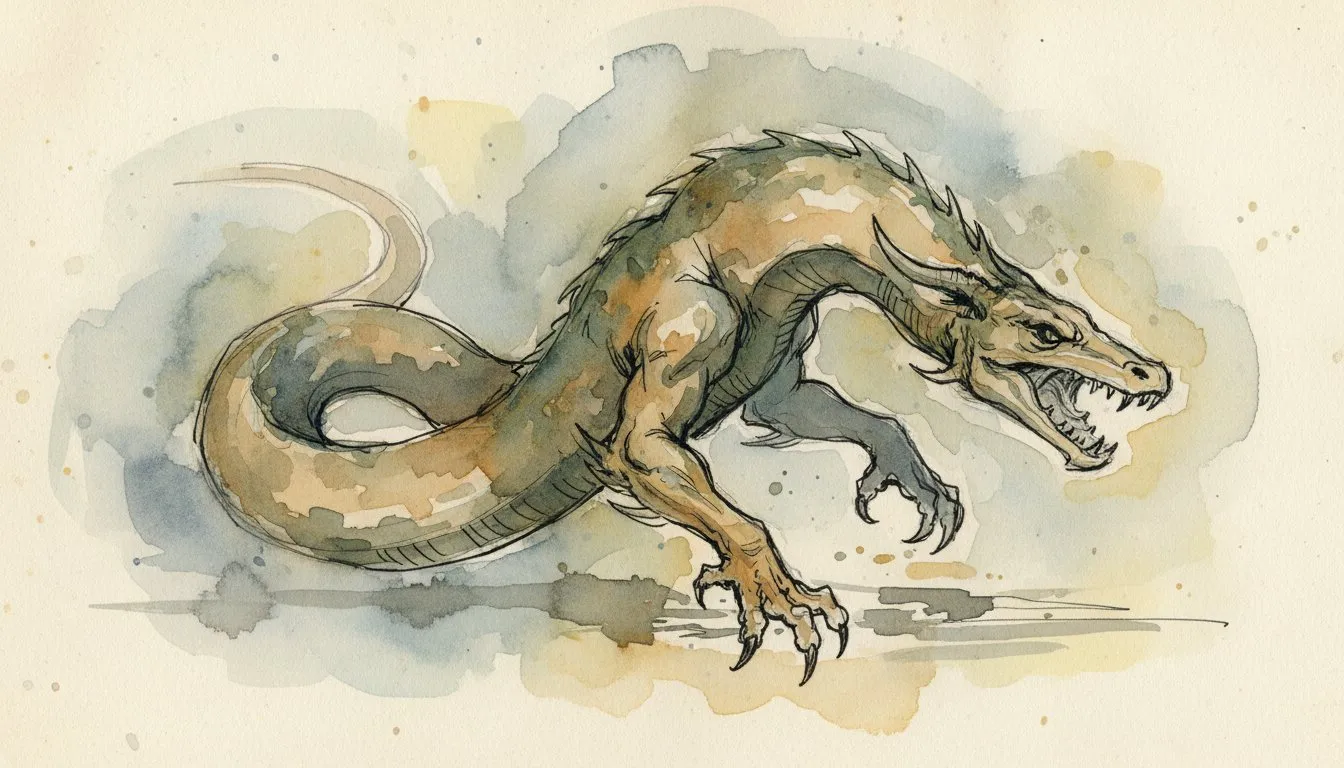
Lindworm
Also known as: Lindorm, Linnorm, Landwurm
A legless or two-legged dragon slithers through Scandinavian and Germanic legends as a creature of both terror and strange wisdom.
Norse sagas, pre-1000 CE
Scandinavia and Germanic regions
Varies wildly, 10 feet to enormous
Aggressive, territorial, guards treasure
Folklore tradition, no modern sightings
The Lore
The Lindworm is a serpentine dragon from Scandinavian and Germanic tradition, typically described as having no legs or only two front legs. Unlike winged dragons, it is earthbound and often associated with burial mounds, treasure hoards, and cursed royal bloodlines. Historical accounts from medieval Sweden describe lindworms spotted crossing roads or coiled around churches. The creature appears in heraldry across Northern Europe and features prominently in the fairy tale of Prince Lindworm, where a cursed prince must be uncoiled from his serpent skin.
Before sea serpents, before winged dragons, before the standardized monsters of medieval heraldry, Northern Europe feared the Lindworm. One of the oldest cryptid archetypes in Germanic and Norse tradition, the Lindworm is a great serpent-dragon, typically legless or with small vestigial forelimbs, enormously long, venomous, and inhabiting forests, rocky hills, and the approaches to villages rather than the sea. The name descends from Old Norse linnr, meaning serpent, and has cognates in Old English, Old High German, and across the Scandinavian languages, marking the creature as pan-Germanic.
Lindworms appear in the oldest strata of Northern European literature. The serpent Fafnir, slain by Sigurd in the Volsunga Saga, is essentially a Lindworm in form, a venomous earth-bound dragon coiled around treasure rather than a winged beast of the air. The Beowulf poet's dragon shares key anatomical features. Medieval Scandinavian chronicles, including those collected by Olaus Magnus in the sixteenth century, report sightings of enormous serpents in Swedish and Norwegian forests, and regional heraldry from Austria to the Baltic preserved the Lindworm as a coat-of-arms element, most famously in the city of Klagenfurt, where a monumental Lindwurm fountain erected in 1593 commemorates a local dragon legend.
The folkloric Lindworm also plays a distinct narrative role that separates it from its fire-breathing cousins. In Scandinavian fairy tales collected by Asbjørnsen and Moe and later by the Brothers Grimm, the Lindworm frequently appears as a cursed prince, a royal child born in serpent form due to a broken taboo, who must be transformed back through a ritual involving a courageous bride, multiple layers of clothing, and a lash of whips. The tale of King Lindworm survives in dozens of versions across the Nordic region and shows how deeply the creature was woven into social rather than purely monstrous imagination.
Cryptozoologically, the Lindworm is significant less as a candidate species than as evidence that large serpent-like cryptid reports in Europe have very deep roots. Modern Scandinavian tradition preserves occasional accounts of immense snakes seen in remote lakes or forests, sometimes filed under Lindworm and sometimes under more recent labels. The creature reminds us that cryptozoology does not begin with Victorian naturalists or American pulp magazines. It is continuous with a mythic landscape whose oldest layers were already ancient when they were first written down.
Media Appearances
- Prince Lindworm (fairy tale)
- God of War (video game series)
Further Reading
No book is devoted to this creature. These are the general references that cover the field, plus a direct search if you want to dig further.
- Cryptozoology A to Z by Loren Coleman and Jerome Clark (1999)
The standard one-volume encyclopedia, roughly two hundred entries covering creatures, investigators, and hoaxes.
- Mysterious Creatures: A Guide to Cryptozoology by George M. Eberhart (2002)
The larger reference guide, stronger on sourcing and on creatures that never reached the popular books.
Search Amazon for Lindworm books
As an Amazon Associate, Cryptid Vault earns from qualifying purchases. Links open Amazon in a new tab.
Get the Field Notes.
Field notes from the Vault, when there is something worth sending. No spam.
No spam. Unsubscribe anytime.
You might also like
Tatzelwurm
A stubby, venomous dragon-cat with two front legs haunts the caves and cliffs of the European Alps.
Lagarfljot Worm
Iceland's answer to the Loch Ness Monster lives in a glacial river-lake and may have been sighted on camera in 2012.
Sirrush
A scaly, long-necked dragon depicted on the Ishtar Gate of Babylon stands among real animals, leading some to argue it was drawn from life.
Ajatar
A Finnish forest spirit that spreads disease and madness to anyone who catches a glimpse of her moving through the trees.
Brosno Dragon
Russia's lake monster reportedly swallowed a Mongol war party's horses whole and has been spotted by modern fishermen with sonar equipment.
Selma
Norway's lake monster has been sighted over 500 times in a small mountain lake, making it one of the most reported freshwater cryptids in Europe.
Storsjoodjuret
Sweden's most famous lake monster has been reported for centuries and was officially designated a protected species in 1986.
Morag
Scotland's other lake monster lurks in the deepest freshwater loch in the British Isles, far from the tourist cameras of Loch Ness.